Artificial Intelligence Services
Enterprise AI services
Consulting, integration, automation, autonomous agents: Ovyka helps organizations move from AI ideas to systems that are actually used, scoped, and governed over time.
We combine Atlassian integration, workflow automation, autonomous agents, and multi-agent architectures to turn repetitive tasks, continuous analysis, and business assistance into operational leverage.
01 Prioritize business-value use cases
02 Integrate with Jira, Confluence, APIs, and the wider IS
03 Governed agents and workflows, not isolated prototypes
What is our AI expertise for?
The point is not simply adding a generative model. You need to choose the right use cases, connect the useful data, and keep control over automated actions.
Automate repetitive work
Reduce manual processing, follow-ups, consolidation, and routine actions that consume time without creating much value.
Assist key roles
Support Scrum Masters, PMOs, CIO teams, support teams, and business owners with contextual summaries, prioritization, and checks.
Generate continuous analysis
Monitor tickets, data, indicators, or KPI deviations to produce actionable alerts and summaries.
Orchestrate multiple systems
Connect Atlassian tools, APIs, collaborative platforms, and business data through intelligent workflows.
Our AI services and solutions
What we implement
We adapt ambition to your maturity: quick activation of native AI capabilities, cross-tool automation, then more specialized agents when the use case requires them.
AI inside Atlassian solutions
Use native Atlassian AI capabilities and Rovo to accelerate writing, prioritization, summaries, contextual search, and existing workflows.
Discover Rovo
Advanced automation with n8n
Design intelligent automations that orchestrate tools, enrich data, trigger notifications, and generate reports.

Autonomous background agents
Delegate long-running processing, ticket analysis, indicator monitoring, or result publication to Jira, Confluence, or a third-party system.
Orchestrators and specialized agents
Break a complex request into atomic tasks handled by targeted agents: classification, synthesis, business calculation, verification, or enrichment.
Governance, security, and adoption
Define scopes, validation rules, information-system integrations, responsibilities, and adoption practices to avoid uncontrolled AI experiments.
Ovyka support
From idea to usable system
Our work secures the transition from experimentation to real operation, with a progressive path that teams can understand and maintain.
- 01
Identify pain points, volumes, available data, and expected benefits.
- 02
Scope priority use cases and the limits of human or automated decision-making.
- 03
Design the AI architecture, integrations, agents, and governance rules.
- 04
Prototype quickly on a controlled scope, then measure business usefulness.
- 05
Industrialize workflows, train teams, and organize continuous improvement.
Typical use cases
The first gains often come from flows that are already known, but too manual, scattered, or dependent on scarce expertise.
Enriched synchronization between tools
Create, complete, or reconcile information between Jira, Confluence, APIs, and business tools.
Automated data processing
Clean, classify, extract, transform, or enrich information before decision-making or publication.
Intelligent reports
Generate recurring summaries, meeting notes, portfolio analysis, or status updates.
Contextual notifications
Notify only when the context justifies it, with the right summary and the next useful action.
Support for agile and IT teams
Help with team follow-up, ceremony preparation, ticket analysis, and prioritization.
Critical indicator monitoring
Detect anomalies, deviations, or drift against defined rules and KPIs.
Advanced architecture
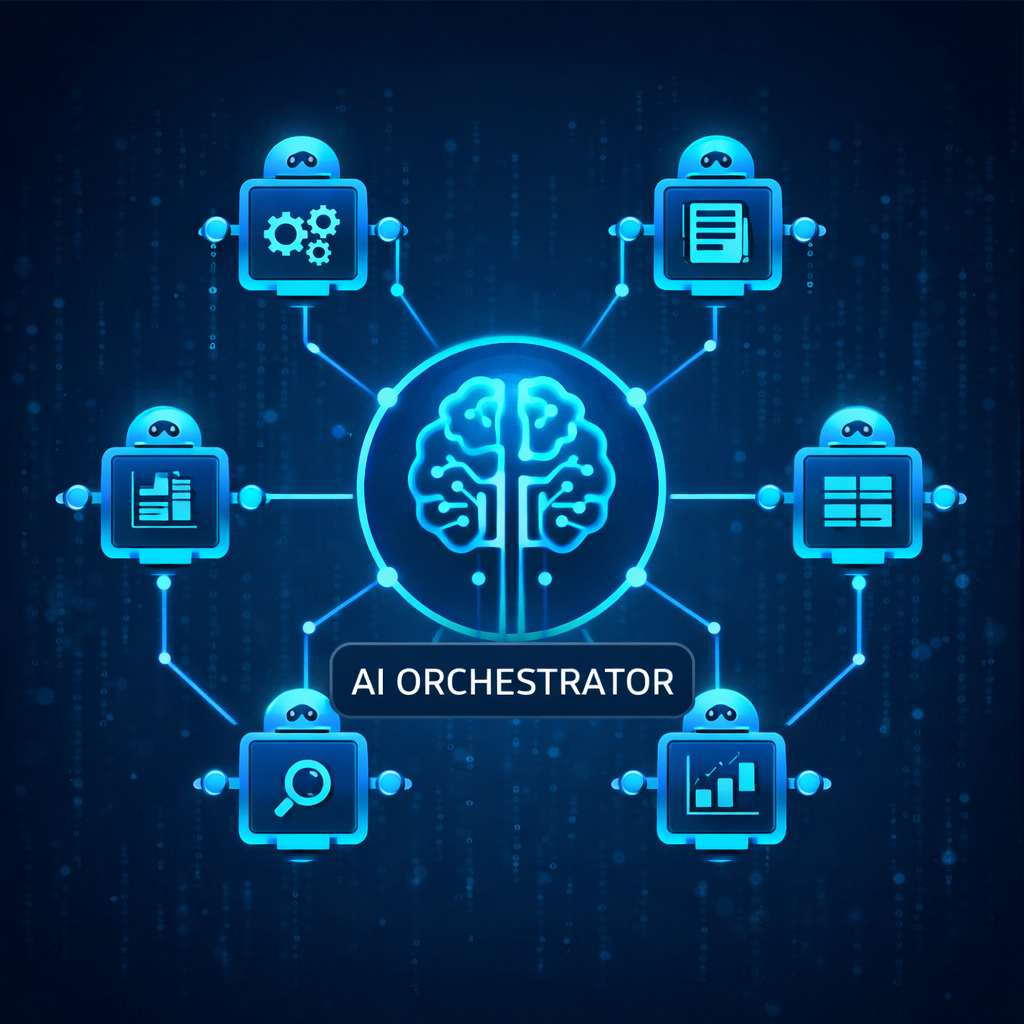
Orchestrators and specialized agents
Rather than assigning everything to a generic agent, Ovyka designs distributed systems where each agent has a clear, optimized role.
The orchestrator analyzes the request, discovers context, breaks the task into coherent sub-problems, and triggers the right agents: data analysis, classification, synthesis, targeted generation, verification, enrichment, or business calculation.
This approach requires more upfront design, but gives stronger control over quality, costs, and long-term scalability.
- Better control of context and answer quality
- Reduced token and resource consumption
- Use of lighter but effective models
- Modular, scalable architecture that is easier to evolve
- Clearer architectural, budgetary, and operational control
Pragmatic, governed, adoptable AI
We help establish the rules that make AI use sustainable: where AI decides, where it assists, where human validation remains necessary, and how outputs are monitored.
Responsibility, action-scope, and validation-rule framing
Connection to existing sources and tools instead of new silos
Change support for the teams that will use the workflows
Progressive rollout: start useful, measure, improve, extend
Ovyka
Do you have an AI use case to frame?
We can help you distinguish what needs simple automation, an AI workflow, an autonomous agent, or a more advanced orchestration architecture.